Phyllocnistis (5S)
Head smooth; antenna 4/5 length of forewing
|
090 Phyllocnistis saligna
(Willow Maze-miner) |
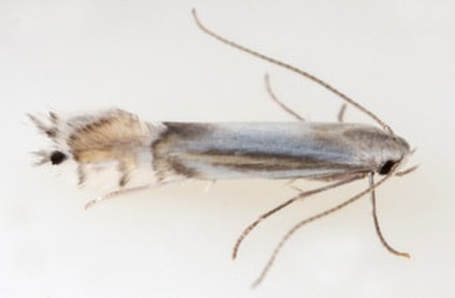
0905 Phyllocnistis asiatica
(Asian Maze-miner) Externally similar to P.saligna, but has a different leaf-mine and genitalia. Accepted as a distinct species in 2018 and found at Wicken Fen, Cambridgeshire. Lfp Salix spp Added to main list in 7th update (Jan 2024) 091 Phyllocnistis ramulicola (Willow-stem Maze-miner) ws:6-7mm; grey,goat & eared willow (Salix spp); NS-A discovered in Hampshire 2007 and occurs also in adjacent counties |
|
092 Phyllocnistis unipunctella
(Poplar Maze-miner) |
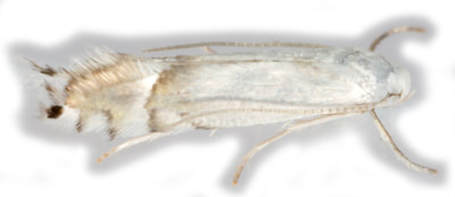
093 Phyllocnistis xenia
(Kent Maze-miner) ws:6-7mm; bivoltine Jul-Aug, Sep-Apr; grey/white poplar (Populus canescens/alba); NS-B new to UK in Kent in 1974, now spreading through SE.England 0932 Phyllocnistis extrematrix (Poplar-stem Maze-miner) New to Britain 2025; black poplar (Populus nigra) |
Key to Phyllocnistis
Long basal streak |
4 Salix-feeders |
|||
Basal streak to ~½ |
f1&2 merged angulate |
P.triandricola |
||
Basal streak to ~⅔ |
f2 angulate |
P.ramulicola |
||
f2 curved |
markings brown |
P.saligna |
||
markings yellowish |
P.asiatica |
|||
No basal streak |
2 Populus-feeders |
|||
median dorsal fuscous spot |
P.xenia/extrematrix |
|||
not as above |
P.unipunctella |
Ref: Taxonomy of the Phyllocnistis saligna (Zeller, 1839) complex (Lepidoptera, Gracillariidae) in North and Central Europe, with the description of a new species. Voith et al.Norwegian Journal of Entomology 22/06/2023
The Salix-feeding Phyllocnistis species have a long forewing streak from the base (Populus-feeding species lack this streak) and two transverse fasciae at ~⅔
In P.triandricola (not yet British) the basal streak is short (to ~½) and does not reach the first transverse fascia; in the other 3 species it is longer (to ~⅔) and does reach the first transverse fascia.
In P.saligna (not yet confirmed as British) and P.asiatica fascia 1 is obsolete in its dorsal half and fascia 2 is curved
In P.triandricola (ws: 7.5-8.0mm) fascia 1 & 2 merge to form a broad angulate band
In P.ramulicola (ws: 5.7-7.0mm) fascia 1 is reduced to a short oblique costal streak and fascia 2 is angled (90-130°.
P.asiatica is paler than P.saligna with the markings yellowish rather than brown.
P.asiatica shows seasonal dimorphism – this is not described in the paper for this species but may be similar to that of the non-British species P.valentinensis in which the white parts at the base of the forewing of the summer generation are suffused grey in the overwintering generation.
Male genitalia of the 4 Salix-feeding species are indistinguishable.
Female genitalia:
P.ramulicola has 2 signa of unequal size, the other 3 species have 2 equal signa.
P.triandricola, asiatica and saligna can be distinguished from each other on features of a parallel pair of sclerites in the ovipositor.
P.triandricola: flat, less well-sclerotised and broader at the dorsal end (l: 81-103μm)
P.asiatica (l: 98-122μm) & P.saligna (l: 58-70 μm): more 3-D and curved (resulting in variations in appearance due to differential pressure from cover slip application). In P.saligna these sclerites are pointed at both ends, in P.asiatica they are longer, broader and may be irregular in shape.
The Salix-feeding Phyllocnistis species have a long forewing streak from the base (Populus-feeding species lack this streak) and two transverse fasciae at ~⅔
In P.triandricola (not yet British) the basal streak is short (to ~½) and does not reach the first transverse fascia; in the other 3 species it is longer (to ~⅔) and does reach the first transverse fascia.
In P.saligna (not yet confirmed as British) and P.asiatica fascia 1 is obsolete in its dorsal half and fascia 2 is curved
In P.triandricola (ws: 7.5-8.0mm) fascia 1 & 2 merge to form a broad angulate band
In P.ramulicola (ws: 5.7-7.0mm) fascia 1 is reduced to a short oblique costal streak and fascia 2 is angled (90-130°.
P.asiatica is paler than P.saligna with the markings yellowish rather than brown.
P.asiatica shows seasonal dimorphism – this is not described in the paper for this species but may be similar to that of the non-British species P.valentinensis in which the white parts at the base of the forewing of the summer generation are suffused grey in the overwintering generation.
Male genitalia of the 4 Salix-feeding species are indistinguishable.
Female genitalia:
P.ramulicola has 2 signa of unequal size, the other 3 species have 2 equal signa.
P.triandricola, asiatica and saligna can be distinguished from each other on features of a parallel pair of sclerites in the ovipositor.
P.triandricola: flat, less well-sclerotised and broader at the dorsal end (l: 81-103μm)
P.asiatica (l: 98-122μm) & P.saligna (l: 58-70 μm): more 3-D and curved (resulting in variations in appearance due to differential pressure from cover slip application). In P.saligna these sclerites are pointed at both ends, in P.asiatica they are longer, broader and may be irregular in shape.
